Industrial Ready-Mix Concrete for Demanding Real-World Applications
Industrial facilities place different demands on concrete depending on the application, anticipated loads, exposure conditions, placement requirements, and long-term performance expectations. Developers, engineers, and contractors may specify ready-mix concrete for warehouses, loading docks, parking areas, manufacturing facilities, foundations, and other demanding applications where the concrete mixture must be appropriate for the project's structural and performance requirements.
For many industrial applications, strength and durability are among the primary performance considerations. Concrete used in warehouses, manufacturing facilities, loading docks, and storage yards may be subjected to heavy wheel loads, abrasion, impact, moisture exposure, and repeated daily use. Understanding how these conditions influence concrete specifications can help project teams select an appropriate mixture for long-term performance.
ASTM C94/C94M covers ready-mixed concrete manufactured and delivered to a purchaser in a freshly mixed and unhardened state. Concrete mixtures typically combine cementitious materials, aggregates, water, and, when needed, chemical or air-entraining admixtures selected to achieve specified fresh and hardened concrete properties.
Why Industrial Facilities Have Different Concrete Requirements
Industrial concrete is often specified for environments exposed to heavy wheel loads, repetitive traffic, equipment vibration, impact forces, abrasion, moisture, and demanding service conditions. Warehouses, manufacturing facilities, loading docks, agricultural buildings, and industrial yards place different demands on concrete than conventional residential or light commercial applications.
According to the National Ready Mixed Concrete Association (NRMCA), durability is influenced by factors such as permeability, environmental exposure, freeze-thaw conditions, chemical exposure, and construction quality. Industrial environments often require these considerations to be evaluated alongside compressive strength when developing project specifications.
Before specifying a concrete mixture, project teams consider anticipated loads, exposure conditions, slab or structural requirements, reinforcement, jointing, floor flatness or finish requirements, durability expectations, and intended service conditions. These factors influence the performance requirements used to develop an appropriate concrete mixture for the application.
Key Design Considerations for Industrial Concrete
Industrial concrete selection extends beyond compressive strength alone. Engineers, developers, contractors, and facility owners often evaluate loading conditions, durability requirements, constructability, lifecycle performance, and project specifications before finalizing a concrete mix design.
Load Requirements
Industrial floors, foundations, loading areas, and equipment pads may be subjected to forklifts, delivery vehicles, storage systems, machinery, and repetitive traffic. Anticipated loads influence concrete strength requirements, slab thickness, reinforcement strategies, and joint design.
Durability Requirements
Moisture exposure, abrasion, chemicals, weather conditions, and heavy traffic can affect long-term performance. Concrete mixtures are often designed to address these conditions through proper material selection, admixture use, reinforcement design, and curing practices.
Concrete durability is often influenced by permeability, which affects the movement of water and potentially harmful substances into the concrete. Depending on project conditions, mixture designs may incorporate admixtures intended to reduce permeability, mitigate corrosion risks around reinforcing steel, or improve resistance to abrasion and environmental exposure.
Lifecycle Performance
Many facility owners evaluate maintenance requirements, repair frequency, expected service life, and total lifecycle costs alongside initial construction costs when selecting materials for industrial facilities.
Constructability and Scheduling
Delivery logistics, placement methods, finishing requirements, curing conditions, weather, and construction sequencing all influence project success. Early coordination between the engineer, contractor, and concrete supplier can improve efficiency during construction.
How Do Mixture Requirements Change by Application?
The ingredients in a concrete mix can be customized to meet the unique specifications of each project. Industrial concrete mixtures can be proportioned for project-specific requirements such as strength, workability, permeability, durability, placement conditions, and environmental exposure. Depending on the application, admixtures may be used to modify properties such as workability, setting characteristics, water penetration, or durability. Final mixture requirements should be coordinated with the project's design, specifications, placement conditions, and performance expectations.
These performance characteristics directly affect long-term durability and maintenance requirements. Lower permeability can help reduce moisture intrusion, while corrosion-inhibiting admixtures may be specified to help protect reinforcing steel in aggressive environments. Other admixtures may be used to improve workability, strength development, freeze-thaw durability, or finishing characteristics depending on project requirements.
Project specifications should define the performance requirements the concrete mixture needs to achieve rather than treating every industrial application the same. ASTM C94/C94M establishes requirements for the production and delivery of ready-mixed concrete, while project specifications may establish additional requirements for strength, slump, air content, temperature, materials, testing, and other performance criteria.

How Ready-Mix Requirements Vary Across Applications
Concrete requirements vary considerably by project. The following Central Florida applications illustrate how structural design, construction method, placement conditions, exposure, and intended use can influence ready-mix selection.
Because loading conditions, environmental exposure, and service expectations vary significantly among industrial projects, engineers typically evaluate performance requirements before selecting a concrete mixture. Compressive strength, permeability, abrasion resistance, and constructability requirements may differ substantially between industrial floors, tilt-up wall panels, foundations, and agricultural facilities.
County Materials offers industrial concrete blended with admixtures that can improve strength, reduce permeability, and support project-specific performance requirements.
Ascend at Kelly Park
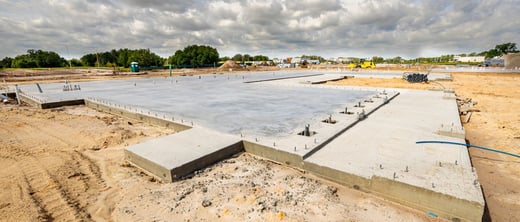
Post-tensioned foundation systems often require concrete mixtures that support specified strength development and placement requirements while accommodating project sequencing and structural design criteria. County Materials supplied 3,000 cubic yards of a specialty mix for the foundation of this apartment complex in Apopka, Florida. The concrete mixture was developed to support the requirements of the project's post-tensioned foundation system.
Morsco HVAC Supply
This industrial office and warehouse in Apopka, Florida, utilized tilt-up construction. Concrete wall panels are cast horizontally before being lifted into position by crane. Concrete mixture requirements for tilt-up panels depend on the project's structural design, lifting requirements, specified strength, placement, and finishing conditions.
Unlike conventionally cast structural elements, tilt-wall panels experience lifting and handling forces before installation. Because of these temporary stresses, flexural performance, early strength development, and dimensional stability are important design considerations. County Materials supplied ready-mix formulated for the project's tilt-up construction requirements.

Mirada
This project in San Antonio, Florida, required a foundation system capable of supporting long-term structural loads while maintaining schedule efficiency during construction. Industrial ready-mix was specified to meet the project's structural and durability requirements. County Materials supplied a specialty concrete mixture for a post-tensioned foundation system. The project illustrates how ready-mix selection must align with structural design requirements as well as placement, sequencing, and construction conditions.
Dry Dox RV & Boat Storage
Nearly 2,500 cubic yards of County Materials ready-mix were supplied for two large floor slabs at this boat and RV storage facility in Tavares, Florida. For large slab applications, project teams should consider anticipated traffic and loading, jointing, finishing, curing, exposure, and long-term maintenance requirements when developing the concrete specification. Properly designed and maintained industrial concrete structures can provide a service life of 30 years or more with relatively low maintenance requirements. Actual service life depends on mixture design, environmental exposure, loading conditions, construction quality, and maintenance practices.
Bay Lake Farm
Ready-mix concrete is commonly selected for agricultural and industrial facilities because it can withstand heavy equipment traffic, weather exposure, impact, and demanding daily operations when properly designed and maintained. Agricultural and processing facilities can expose concrete to heavy equipment, frequent use, moisture, weather, and other site-specific conditions. The contractor chose County Materials to supply 25 cubic yards of industrial concrete for this farm’s alligator meat processing facility.

Coordinating the Concrete Mixture with Project Requirements
Ready-mix concrete can be proportioned to address different structural, construction, and exposure requirements. Early coordination among the design professional, contractor, and concrete producer can help ensure the specified mixture is appropriate for the project and practical to produce, deliver, place, finish, and cure. Ready-mix concrete, according to the NRMCA, is remarkably strong, durable, and economical. When blended with admixtures, it can serve a diversity of industrial applications.
The appropriate industrial concrete mixture should be determined by the project's required structural performance, exposure conditions, construction methods, and long-term service expectations rather than a one-size-fits-all approach.
When evaluating industrial concrete, project teams should consider strength requirements, anticipated loading, durability expectations, environmental exposure, placement conditions, and lifecycle performance together. Optimizing one characteristic without considering the others may not produce the most effective solution for the application.
The County Materials’ team works closely with developers and their project teams to supply ready-mix that meets the unique structural and performance needs of each project. County Materials’ Central Florida dispatch and delivery team supports coordination of mixture requirements and concrete delivery for projects throughout the region.
Learn how County Materials’ specialists can help identify an industrial ready-mix solution tailored to your structural demands, construction schedule, and long-term service objectives. Contact our Customer Service Team at (708) 562-7700.